
Best IR Camera for Cars: Night Vision & Safety Thermal Imaging 2026
"IR camera" and "thermal camera" are often used interchangeably when drivers search for night vision solutions for their vehicles, but they describe different technologies. Understanding the distinction helps you find the right system for your actual use case. This collection covers the InsightDrive thermal imaging systems and clarifies what type of infrared detection is most effective for automotive nighttime hazard detection.
IR Camera vs. Thermal Camera: The Practical Difference
Both technologies use infrared radiation, but in fundamentally different ways:
- Near-infrared (NIR) cameras — often called "IR cameras" — use an active illuminator to project near-infrared light and capture the reflection. They function like a standard camera but in the IR spectrum. Range is limited by the illuminator output, typically 50–150m for automotive applications. Performance degrades beyond illuminator range and can be affected by oncoming headlights.
- Thermal imaging cameras detect mid-wave or long-wave infrared radiation emitted by objects based on their temperature. No illuminator is required. A deer at body temperature emits heat that the sensor detects clearly against a cooler background at up to 200m, regardless of ambient light or other light sources.
When drivers search for an "IR camera for cars" to detect deer and pedestrians at night, thermal imaging is the technology that addresses this need most directly. The InsightDrive is a thermal imaging system, not a near-infrared camera.
What the InsightDrive Provides
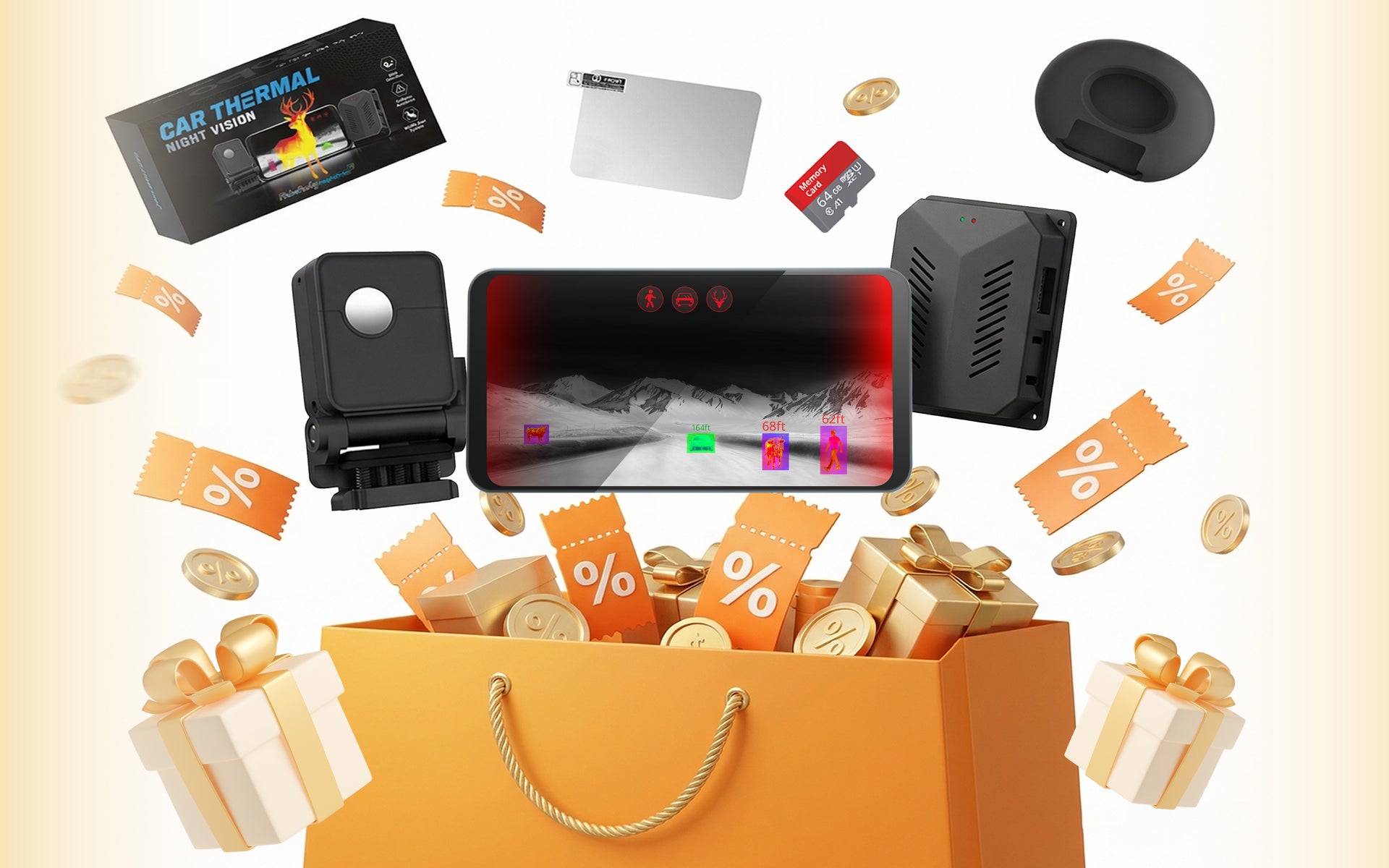
- Passive thermal detection at up to 200m / 656ft — no illuminator, no range limit from light output
- AI classification of detected objects as animals, pedestrians, or vehicles
- Real-time collision risk alerts when a detected object is on a trajectory toward the vehicle
- Performance unaffected by oncoming headlights, complete darkness, or light fog
- 12V compatibility for standard passenger vehicles; 24V with converter for commercial trucks
When a Near-Infrared Camera May Be More Appropriate
NIR cameras produce a more visually detailed image within their illuminator range and can capture license plates and fine visual detail that thermal imaging cannot. If your primary need is recording visible-light-equivalent footage at night for security or documentation purposes rather than long-range hazard detection, a NIR camera may be more appropriate for that specific use case. For detecting animals and pedestrians at distance on unlit rural roads, thermal imaging is the more effective technology.
Frequently Asked Questions
Can the InsightDrive read license plates?
No. Thermal imaging detects heat signatures rather than visible-light detail. License plates, road signs, and vehicle colors are not captured in a thermal image. If license plate capture is a requirement, a visible-light or NIR camera is needed for that function.
Is the InsightDrive affected by IR light from other vehicles?
No. The InsightDrive detects thermal radiation emitted by objects, not reflected near-infrared light. IR illuminators from other vehicles or security cameras do not affect the thermal image.
Does the system work without any external light source?
Yes. Thermal imaging requires no external light source of any kind. The system detects heat emitted by objects and functions in complete darkness, with no performance dependency on headlights, street lighting, or any illuminator.
Browse the InsightDrive thermal systems in this collection. Contact Robofinity for compatibility questions before ordering.
Filters
2 products