

Vehicle Thermal Imaging Systems | Detect Pedestrians, Animals & Obstacles in Darkness
Vehicle thermal imaging systems are a category of driving assistance technology that uses passive infrared sensors to detect heat-emitting objects — animals, pedestrians, and vehicles — at distances beyond standard headlight range. Unlike visible-light cameras, thermal sensors do not require ambient light or active illumination to produce a usable image. This collection covers the InsightDrive thermal imaging systems for passenger vehicles and commercial vehicles, with a focus on helping buyers understand the technology and select the right system configuration for their vehicle type and use case.
Core Technology: How Vehicle Thermal Imaging Works
A thermal imaging sensor is a focal plane array (FPA) that measures the intensity of infrared radiation emitted by objects in its field of view. Every object above absolute zero emits infrared radiation proportional to its temperature. A deer at 38°C body temperature emits significantly more infrared radiation than a road surface at 10°C, producing a high-contrast image that the sensor resolves clearly regardless of ambient light. The InsightDrive processes this sensor output through an AI classification layer that identifies object type — animal, pedestrian, or vehicle — and calculates collision trajectory in real time.
Uncooled vs. Cooled Thermal Sensors
Automotive thermal imaging systems use uncooled microbolometer sensors rather than cooled sensors. Cooled sensors offer higher sensitivity but require cryogenic cooling systems that are impractical for vehicle applications. Uncooled sensors operate at ambient temperature, are compact, consume low power, and are durable enough for vehicle-mounted use. The InsightDrive uses an uncooled thermal sensor appropriate for automotive detection ranges and operating conditions.
System Components
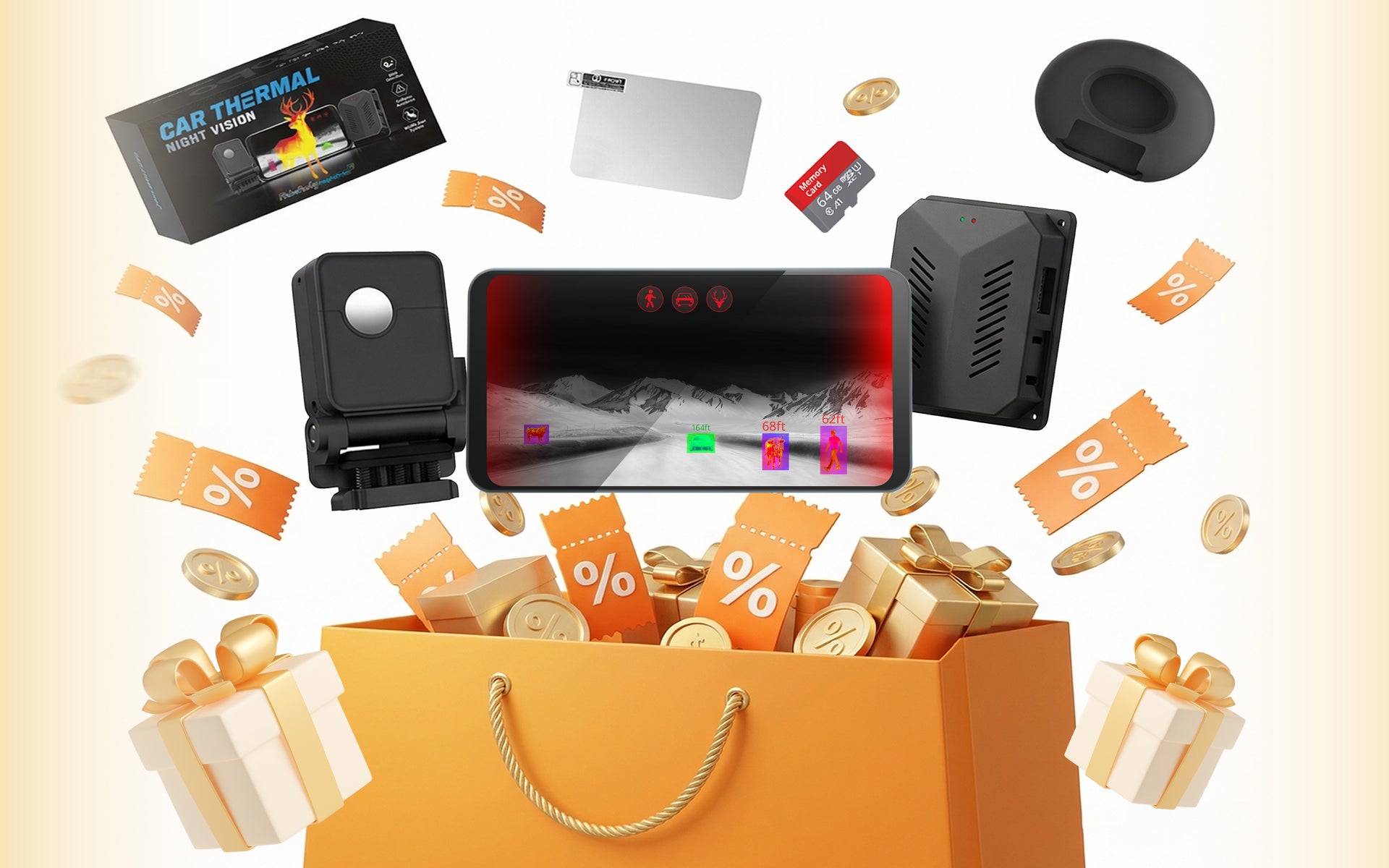
- Thermal camera unit: The forward-facing sensor and housing, mounted at the front of the vehicle
- AI processing unit: Classifies detected objects and calculates collision risk in real time
- Alert output: Issues collision risk alerts when a detected object is on a trajectory toward the vehicle
- Video output: Thermal image feed via HDMI, VGA, or RCA to a connected display
- Power input: 12V (passenger vehicles) or 24V with converter (commercial vehicles)
Selecting the Right System Configuration
The primary selection decisions for a vehicle thermal imaging system are:
- Voltage variant: 12V for standard passenger vehicles, SUVs, and light trucks; 24V with converter for commercial trucks and specialized vehicles
- Single vs. dual camera: A single forward-facing unit covers the primary detection zone ahead of the vehicle. A dual configuration adds a second camera for additional coverage angles, relevant for larger vehicles or specific installation requirements.
- Display connection: Confirm whether your vehicle has a compatible HDMI, VGA, or RCA input on an existing screen, or plan for a dedicated display
- Mounting accessories: Lens holders, brackets, and lens protectors support correct positioning and protection in different vehicle and environment types
Performance Parameters to Understand
| Parameter | InsightDrive Specification | What It Means |
|---|---|---|
| Detection range | Up to 200m / 656ft | Maximum distance at which animals, pedestrians, and vehicles are detectable |
| Sensor type | Uncooled microbolometer | No cooling required; suitable for vehicle-mounted use |
| Object classification | AI: animal / pedestrian / vehicle | System identifies object type before issuing alert |
| Alert type | Real-time collision risk alert | Alert issued when detected object is on collision trajectory |
| Power requirement | 12V / 24V (with converter) | Compatible with standard passenger and commercial vehicle electrical systems |
Frequently Asked Questions
What is the difference between thermal imaging and near-infrared night vision?
Near-infrared (NIR) systems use an active illuminator to project IR light and detect the reflection — similar to a standard camera but in the IR spectrum. They require the illuminator to function and have a range limited by illuminator output. Thermal imaging detects heat emitted by objects without any illumination, operates at greater distances, and is not range-limited by an illuminator. Thermal imaging is generally more effective for long-range animal and pedestrian detection in complete darkness.
Does the system require calibration after installation?
The InsightDrive does not require vehicle-specific calibration or dealer programming after installation. The AI classification system operates from the thermal image without requiring calibration to the host vehicle's parameters. Angle adjustment of the camera mount after installation is recommended to optimize the field of view for the specific mounting height and position on your vehicle.
How does the system perform in extreme temperatures?
Thermal imaging performance is affected by the temperature differential between detected objects and the background environment. In very hot conditions where road surface and ambient temperatures approach animal body temperature, contrast may be reduced. In cold conditions, the differential between warm-bodied animals and a cold background increases, improving contrast. Check the product specifications for the rated operating temperature range.
Browse the systems and accessories in this collection. Contact Robofinity for technical questions or vehicle compatibility before ordering.
フィルター
1 製品

