

Night Vision vs Thermal Imaging: Which Works Better in the Dark?
"Night vision" and "thermal imaging" are often used interchangeably, but they describe different technologies with different performance characteristics in real driving conditions. If you are deciding between a near-infrared night vision system and a thermal imaging system for your vehicle, the choice comes down to what you are trying to detect, at what distance, and in what conditions. This collection covers the Robofinity InsightDrive thermal imaging systems and helps buyers understand where thermal imaging outperforms near-infrared night vision — and where the distinction matters most.
How the Two Technologies Differ
Near-infrared (NIR) night vision works by projecting invisible near-infrared light from an active illuminator and capturing the reflection with a camera sensitive to that wavelength. It produces a black-and-white image that looks similar to a standard camera image. Performance is limited by the illuminator’s range — typically 100–150m for automotive applications — and the image degrades beyond that range. NIR systems are also affected by oncoming headlights, which can wash out the image temporarily.
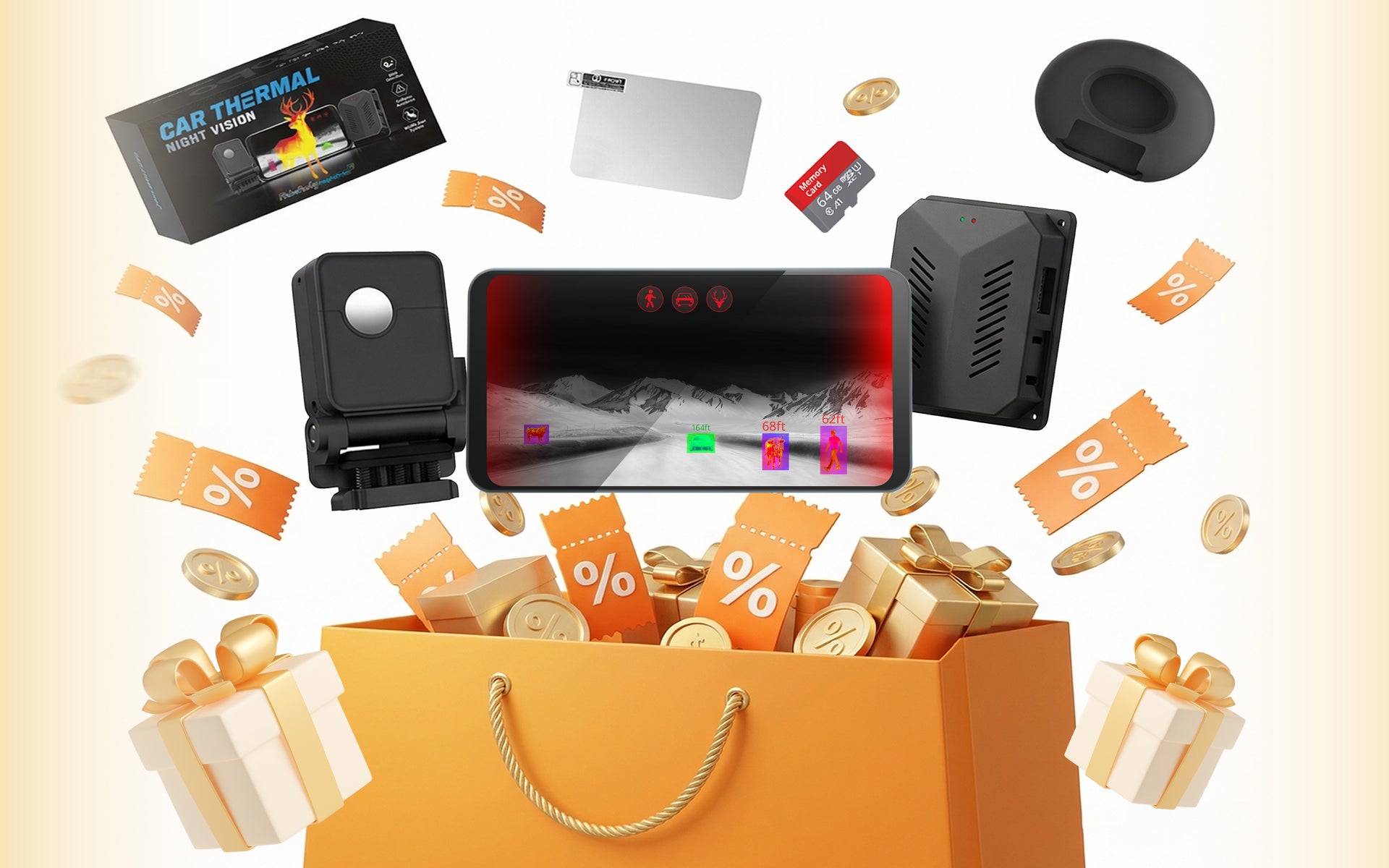
Thermal imaging detects infrared radiation emitted by objects based on their temperature, without any active illumination. It does not project light or require a light source. A deer at 38°C body temperature emits heat that the sensor detects clearly against a cooler background, regardless of ambient light or the presence of other light sources. The InsightDrive detects animals, pedestrians, and vehicles at up to 200m without illumination and is not affected by oncoming headlights or glare.
Head-to-Head Comparison for Automotive Use
| Factor | Near-Infrared Night Vision | Thermal Imaging (InsightDrive) |
|---|---|---|
| Detection principle | Active IR illumination + reflection | Passive heat detection, no illumination |
| Detection range | Typically 100–150m (illuminator-limited) | Up to 200m |
| Performance in complete darkness | Good within illuminator range | Full performance, no range limit from illumination |
| Affected by oncoming headlights | Yes — glare can wash out image | No — not affected by visible light sources |
| Performance in fog | Reduced — IR light scatters in fog | Better — thermal detection less affected by light fog |
| Animal detection at distance | Limited by illuminator range | Detects body heat at up to 200m |
| Image detail | Higher visual detail within range | Heat signature image, no fine visual detail |
| License plate readability | Yes, within illuminator range | No — thermal images do not capture text or color |
| Active illuminator required | Yes | No |
Which Is Better for Animal and Pedestrian Detection?
For detecting animals and pedestrians at distance in complete darkness, thermal imaging has a clear advantage. The absence of an illuminator range limit means thermal imaging can detect a deer at 200m regardless of whether the illuminator would reach that distance. The lack of glare sensitivity means thermal imaging maintains consistent performance in oncoming traffic conditions where NIR systems may be temporarily degraded. For drivers whose primary concern is earlier detection of wildlife and pedestrians on rural roads at night, thermal imaging addresses this more directly than NIR night vision.
When Near-Infrared Night Vision May Be Preferable
NIR night vision produces a more visually detailed image within its illuminator range, which may be preferable for applications where image detail matters — such as reading road signs or identifying vehicle details. Factory NIR systems integrated into luxury vehicles are designed for this use case. For aftermarket installation focused on animal and pedestrian detection at distance, thermal imaging is the more relevant technology.
Frequently Asked Questions
Can I read license plates with a thermal imaging system?
No. Thermal imaging detects heat signatures rather than visible-light detail. License plates, road signs, vehicle colors, and facial features are not captured in a thermal image. If license plate capture is a requirement, a visible-light camera or NIR system within illuminator range is needed for that function.
Does thermal imaging work better than NIR in fog?
In light fog, thermal imaging generally maintains better performance than NIR night vision because it does not rely on projected light that scatters in fog. In very dense fog, both technologies experience reduced performance. Thermal imaging’s advantage over NIR is most significant in light fog and complete darkness conditions.
Are factory luxury car night vision systems NIR or thermal?
Factory automotive night vision systems vary by manufacturer. BMW and Mercedes-Benz have used thermal imaging in their factory systems. Some other manufacturers have used NIR-based systems. The InsightDrive uses passive thermal imaging — the same sensor category as premium factory thermal implementations — in an aftermarket form compatible with most vehicles.
Browse the thermal imaging systems in this collection. Contact Robofinity for compatibility questions before ordering.
필터
상품 1개

